面向对象编程
类和实例是大多数面向对象编程语言的基本概念。在JavaScript中,这个概念需要改一改。JavaScript不区分类和实例的概念,而是通过原型(prototype)来实现面向对象编程。
(1)创建对象
JavaScript的原型链和Java的Class区别就在,它没有“Class”的概念,所有对象都是实例,所谓继承关系不过是把一个对象的原型指向另一个对象而已。
// 原型对象:let Student = {    name: 'Robot',    height: 1.2,    run: function () {        console.log(this.name + ' is running...');    }};
function createStudent(name) {    // 基于Student原型创建一个新对象:    let s = Object.create(Student);    // 初始化新对象:    s.name = name;    return s;}
let xiaoming = createStudent('小明');xiaoming.run(); // 小明 is running...xiaoming.__proto__ === Student; // trueJavaScript对每个创建的对象都会设置一个原型,指向它的原型对象。当我们用obj.xxx访问一个对象的属性时,JavaScript引擎先在当前对象上查找该属性,如果没有找到,就到其原型对象上找,如果还没有找到,就一直上溯到Object.prototype对象,最后,如果还没有找到,就只能返回undefined。
let arr = [1, 2, 3];
Array.prototype定义了indexOf()、shift()等方法,因此你可以在所有的Array对象上直接调用这些方法。函数也是一个对象,
function foo() { return 0;}
由于Function.prototype定义了apply()等方法,因此,所有函数都可以调用apply()方法。如果原型链很长,那么访问一个对象的属性就会因为花更多的时间查找而变得更慢,因此要注意不要把原型链搞得太长。
(2)构造函数
除了直接用{ ... }创建一个对象外,JavaScript还可以用一种构造函数的方法来创建对象。它的用法是,先定义一个构造函数,一个普通函数,但是可以用关键字new来调用这个函数,并返回一个对象:
function Student(name) {    this.name = name;    this.hello = function () {        alert('Hello, ' + this.name + '!');    }}
let xiaoming = new Student('小明');xiaoming.name; // '小明'xiaoming.hello(); // Hello, 小明!
注意,如果不写new,这就是一个普通函数,它返回undefined。但是,如果写了new,它就变成了一个构造函数,它绑定的this指向新创建的对象,并默认返回this,也就是说,不需要在最后写return this;。
用new Student()创建的对象还从原型上获得了一个constructor属性,它指向函数Student本身:
xiaoming.constructor === Student.prototype.constructor; // trueStudent.prototype.constructor === Student; // true
Object.getPrototypeOf(xiaoming) === Student.prototype; // true
xiaoming instanceof Student; // true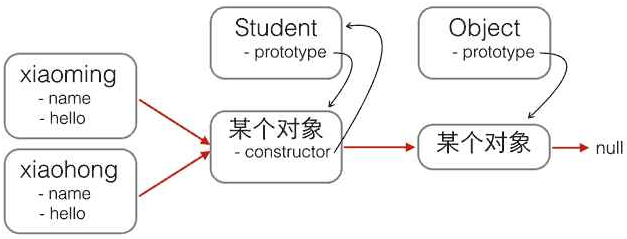
红色箭头是原型链。注意,Student.prototype指向的对象就是xiaoming、xiaohong的原型对象,这个原型对象自己还有个属性constructor,指向Student函数本身。另外,函数Student恰好有个属性prototype指向xiaoming、xiaohong的原型对象,但是xiaoming、xiaohong这些对象可没有prototype这个属性,不过可以用__proto__这个非标准用法来查看。现在我们就认为xiaoming、xiaohong这些对象“继承”自Student。
xiaoming.name; // '小明'xiaohong.name; // '小红'xiaoming.hello; // function: Student.hello()xiaohong.hello; // function: Student.hello()xiaoming.hello === xiaohong.hello; // falsexiaoming和xiaohong各自的name不同,这是对的,否则我们无法区分谁是谁了。
xiaoming和xiaohong各自的hello是一个函数,但它们是两个不同的函数,虽然函数名称和代码都是相同的!
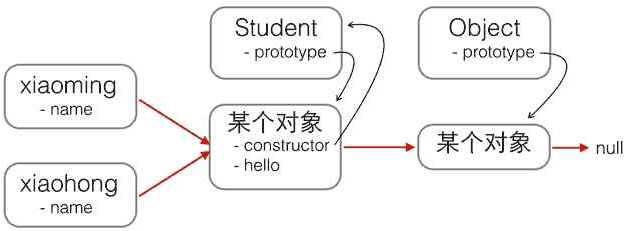
如果我们通过new Student()创建了很多对象,这些对象的hello函数实际上只需要共享同一个函数就可以了,这样可以节省很多内存。
要让创建的对象共享一个hello函数,根据对象的属性查找原则,我们只要把hello函数移动到xiaoming、xiaohong这些对象共同的原型上就可以了,也就是Student.prototype:
function Student(name) {    this.name = name;}
Student.prototype.hello = function () {    alert('Hello, ' + this.name + '!');};
调用构造函数千万不要忘记写
new。为了区分普通函数和构造函数,按照约定,构造函数首字母应当大写,而普通函数首字母应当小写,这样,一些语法检查工具如jslint将可以帮你检测到漏写的new。
(3)原型继承
在传统的基于Class的语言如Java、C++中,继承的本质是扩展一个已有的Class,并生成新的Subclass。由于这类语言严格区分类和实例,继承实际上是类型的扩展。但是,JavaScript由于采用原型继承,我们无法直接扩展一个Class,因为根本不存在Class这种类型。但是办法还是有的。
function Student(props) {    this.name = props.name || 'Unnamed';}
Student.prototype.hello = function () {    alert('Hello, ' + this.name + '!');}
// 正确的继承原型链是: new PrimaryStudent() --> PrimaryStudent.prototype --> Student.prototype --> Object.prototype --> null// 可借助一个中间对象来实现正确的原型链,这个中间对象的原型要指向Student.prototype。中间对象可以用一个空函数F来实现:// PrimaryStudent构造函数:function PrimaryStudent(props) {    Student.call(this, props);    this.grade = props.grade || 1;}
// 空函数F:function F() {}
// 把F的原型指向Student.prototype:F.prototype = Student.prototype;
// 把PrimaryStudent的原型指向一个新的F对象,F对象的原型正好指向Student.prototype:PrimaryStudent.prototype = new F();
// 把PrimaryStudent原型的构造函数修复为PrimaryStudent:PrimaryStudent.prototype.constructor = PrimaryStudent;
// 继续在PrimaryStudent原型(就是new F()对象)上定义方法:PrimaryStudent.prototype.getGrade = function () {    return this.grade;};
// 创建xiaoming:let xiaoming = new PrimaryStudent({    name: '小明',    grade: 2});xiaoming.name; // '小明'xiaoming.grade; // 2
// 验证原型:xiaoming.__proto__ === PrimaryStudent.prototype; // truexiaoming.__proto__.__proto__ === Student.prototype; // true
// 验证继承关系:xiaoming instanceof PrimaryStudent; // truexiaoming instanceof Student; // true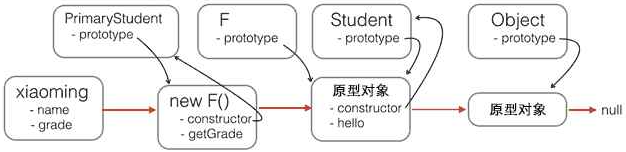
函数F仅用于桥接,我们仅创建了一个new F()实例,而且,没有改变原有的Student定义的原型链。如果把继承这个动作用一个inherits()函数封装起来,还可以隐藏F的定义,并简化代码:
function inherits(Child, Parent) {    let F = function () {};    F.prototype = Parent.prototype;    Child.prototype = new F();    Child.prototype.constructor = Child;}
// 这个inherits()函数可以复用:function Student(props) {    this.name = props.name || 'Unnamed';}
Student.prototype.hello = function () {    alert('Hello, ' + this.name + '!');}
function PrimaryStudent(props) {    Student.call(this, props);    this.grade = props.grade || 1;}
// 实现原型继承链:inherits(PrimaryStudent, Student);
// 绑定其他方法到PrimaryStudent原型:PrimaryStudent.prototype.getGrade = function () {    return this.grade;};
(4)class继承
JavaScript的对象模型是基于原型实现的,特点是简单,缺点是理解起来比传统的类-实例模型要困难,最大的缺点是继承的实现需要编写大量代码,并且需要正确实现原型链。新的关键字class从ES6开始正式被引入到JavaScript中。class的目的就是让定义类更简单。
// 回顾用函数实现Student的方法function Student(name) {    this.name = name;}
Student.prototype.hello = function () {    alert('Hello, ' + this.name + '!');}
// 如果用新的class关键字来编写Student,可以这样写:(这和C++中的类出不多,python也类似)class Student {    constructor(name) {        this.name = name;    }
    hello() {        alert('Hello, ' + this.name + '!');    }}// class的定义包含了构造函数constructor和定义在原型对象上的函数hello()(注意没有function关键字),这样就避免了Student.prototype.hello = function () {...}这样分散的代码。
let xiaoming = new Student('小明');xiaoming.hello();
// 原型继承的中间对象,原型对象的构造函数等等都不需要考虑了,直接通过extends来实现:class PrimaryStudent extends Student {    constructor(name, grade) {        super(name); // 记得用super调用父类的构造方法!        this.grade = grade;    }
myGrade() { alert('I am at grade ' + this.grade); }}注意PrimaryStudent的定义也是class关键字实现的,而extends则表示原型链对象来自Student。子类的构造函数可能会与父类不太相同,例如,PrimaryStudent需要name和grade两个参数,并且需要通过super(name)来调用父类的构造函数,否则父类的name属性无法正常初始化。